
Check Frederick County Voter Registration
The Maryland Voter Lookup is the official first stop for a Frederick County voter checking a personal record. It authenticates a single voter with several details. It is not a public surname index. Enter the name as registered, the full birth date, and the residential ZIP code. A street number and middle initial can narrow the match. The form's controls reveal why it cannot serve as a general people directory.
| Lookup field | Input | Required | Accepted form |
|---|---|---|---|
| First Name | Text | Yes | As registered; letters and spaces |
| Last Name | Text | Yes | Letters, hyphens, and spaces |
| Date of Birth | Month, day, year | Yes | Numeric fields; portal lists years 1921 through 2010 |
| ZIP Code | Five digits | Yes | Residential ZIP on the registration |
| Street Number | Text | No | Optional residential-number refinement |
| Middle Initial | One letter | No | Optional refinement |
When the lookup finds a match, the voter can review registration, districts, polling place, local board, sample ballot, and mail or provisional ballot status. A duplicate registration card can also be requested. If the search fails after a move or name change, retry the former ZIP or former name, then contact the county election office. The system updates daily, yet online and motor-vehicle submissions may take three weeks to appear.
The official Maryland voter lookup page is shown below. Its identity fields separate self-service from open name browsing.
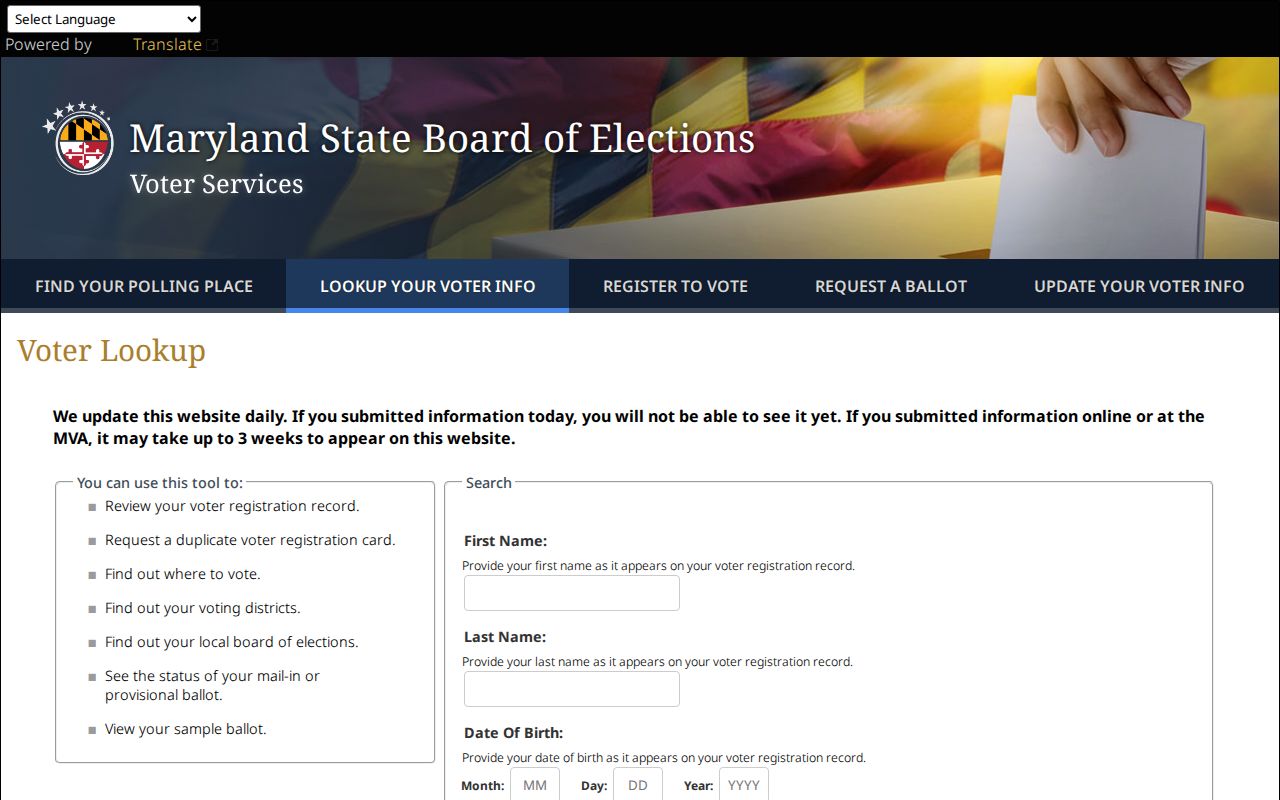
The screenshot also helps a voter prepare the exact name, birth date, ZIP code, and optional address details before starting.
Frederick Voter Lookup Has Limits
A common mistake is to treat the lookup as a searchable countywide roll. It is built for a person to retrieve that person's own election services after identity checks. Typing a surname alone will not produce a list of Frederick County voters. A no-match result also does not prove that no registration exists. Spelling, a former name, a recent move, or processing time may explain the result.
Broader records follow other channels. Election Law § 3-505(b) permits registration-record inspection at the local board under its controls, while § 3-506 sets different terms for obtaining a copy. The original registration record cannot leave the office except under a court order or for temporary processing. General open-record questions belong with the Frederick County public records process, but voter files remain governed by election-specific rules.
Note: Call the local board when an accurate personal lookup still fails; do not infer registration status from one unsuccessful online attempt.
Fields in Maryland Voter Records
The Registered Voters List is broader than the self-lookup result. Its fields support election administration, district assignment, and lawful electoral work. Voting history means whether and how a voter participated in an election, not whom the voter selected. Maryland Election Law § 3-101(b)(6) requires at least five preceding years of that participation history. Ballot choices remain secret.
| Identity | Voter ID, name, party, and gender |
|---|---|
| Addresses | Residential and mailing addresses, subject to protected-address rules |
| Registration | Active or inactive status and state and county registration dates |
| Election geography | Split, precinct, congressional, legislative, councilmanic, ward, municipal or commissioner district, and county |
| Participation history | Election participation for the required period, never a selected candidate or ballot choice |
These fields should be read in context. A district identifies election geography. A precinct is the local voting area used to assign polling and ballot information. Registration dates show administrative events, not how long a person lived in Frederick County. Status likewise calls for care, because list maintenance has legal safeguards.
Frederick Voter Records and Privacy
Maryland separates records available for controlled inspection from data withheld for voter safety. Election Law § 3-506 excludes the residence of an Address Confidentiality Program participant from a copied list. The State Board of Elections voter forms also include a confidentiality request route. Supporting evidence may come from a qualifying service program or professional, the applicant's own statement of fear, or other material accepted by the board.
Protected by election law. Maryland Election Law §§ 3-505 and 3-506 make access conditional, and § 3-506 bars disclosure of a protected program participant's residence in copied voter data.
Participants in Maryland Safe at Home do not need a separate election-board application to suppress the residence. Safe at Home supplies a substitute address and mail forwarding for eligible participants. It cannot pull back an address that was already public, so timing matters. The confidentiality form and Safe at Home serve related but distinct paths.
Frederick Voter Records Desk
The Frederick County Board of Elections is the local offline records desk. It can clarify a failed self-lookup, explain inspection controls, answer questions about county voter data, and point users to election maps, forms, statistics, and past results. The office is at 8490 Progress Drive, Suite 300, Frederick, MD 21701. It is open Monday through Friday, 8 a.m. to 4 p.m.
Frederick County Board of Elections
Phone: 301-600-VOTE (8683)
Fax: 301-600-2344
Email: ElectionBoard@FrederickCountyMD.gov
Maryland State Board of Elections
Data requests: 410-269-2840
Email: dlPSR_sbe@maryland.gov
Role: statewide and fixed-price county or district files
For a Frederick-only product, ask the local board about its current options before buying the state's fixed-price county file. The county's voter data request page is the starting point for local rules and forms. Confirm the current price and delivery terms with that office rather than assuming the state fee applies.
Request Maryland Voter Registration Data
A copied voter file is not available to every requester for any purpose. Under Election Law § 3-506, the applicant must be a registered Maryland voter and submit a written application with a sworn electoral-purpose statement. The oath bars commercial or non-electoral use as well as distribution, sale, or transfer. The State Board's voter-list request form, revised June 30, 2026, sets out the current choices.
- Identify the applicant, registration county or city, contact details, and any organization buying the file. State the intended electoral purpose.
- Select a statewide, single-county or Baltimore City, or single-district region. Choose the list type, history, party and status limits, and delivery method.
- Sign the oath and submit full payment. The state form lists $125 statewide or $75 for one county or district, with a $15 flash-drive add-on; FTP delivery is free.
- Allow up to 10 working days for preparation. Before an election, submit by the advance-registration deadline required by COMAR 33.03.02.05B.
The state accepts credit card, certified, personal, or campaign check, or money order payable to the Maryland State Board of Elections. A returned check costs $30. Most files are tab-separated text, and the Board does not provide import or custom-format help. A walking list is an uneditable precinct PDF arranged by street and is not offered statewide.
Frederick Voter File Choices
The request packet distinguishes products because each serves a different election task. A registered-voter file can be limited to active voters, registration dates, selected parties, or all parties including inactive registrations. History can be included for five elections or ordered separately for listed primary and general elections. Mail-in, provisional, early-voting, and cure products carry fields tied to those processes.
| Product | Useful contents | Delivery detail |
|---|---|---|
| Registered Voter | Identity, address, party, status, dates, precinct, and districts | Tab-separated text |
| Walking List | Voters and party grouped by address within precinct | Locked PDF; not statewide |
| Mail-In | Residence, mailing and ballot addresses, request type and status | Election-specific or permanent list |
| History | Election, voting method and date, precinct, jurisdiction, and county | Included or separate file |
| Early Voting | Site, date, ballot style, precinct, and gender | Election administration file |
Provisional and cure files include more detailed ballot-status and reason fields described in the four-page application. Choose only what the sworn electoral purpose needs. More columns do not broaden the lawful use.
Frederick Voter Status Changes
Active, inactive, and cancelled are administrative labels, not casual judgments about a person. State and local election boards coordinate list maintenance with agency databases and legal notice procedures. Nonvoting alone does not silently cancel a Maryland registration. A voter who moved, changed a name, or recently filed an update should use the personal lookup and contact the local board when the displayed status seems wrong.
Election Law § 3-505(c) requires records of the list-maintenance program to be kept for at least two years. Those records are generally subject to public access, but a person's decision not to register and the identity of the registration agency remain protected. This split permits review of the maintenance process without exposing every private detail behind an individual interaction.
Note: Treat status as an election-office record that may need correction or context, not as proof of any unrelated fact about a person.
Frederick Voter Rolls Before Digital Files
Modern voter registration data should not be confused with historical poll books. The Maryland State Archives Frederick poll-book and voter-list series spans 1808 through 1895. That 87-year range gives genealogists and local historians a record trail long before today's digital voter roll. Some poll books include voter numbers and sworn names of election judges or clerks. Other lists may hold only names and checkmarks.
A related Declaration of Residency List covers 1902 through 1949. These materials can place a named person in an election district or document election administration, but they do not supply modern registration status. Their format also varies by volume and year. Search the Archives description first, then use its item details to identify the right book instead of treating the whole run as one uniform database.
Historical participation records still do not disclose ballot choices. Their value lies in names, place, district, and the civic record preserved by Frederick County election officials across generations.
Lawful Use of Frederick Voter Records
The voter-data oath has real force. Election Law § 3-506 and COMAR 33.03.02 limit copied lists to electoral-process purposes and bar commercial solicitation, non-electoral use, and distribution, sale, or transfer. The state form states that misuse is a misdemeanor punishable by 30 days to six months, a fine up to $250, or both. Public availability of some fields never authorizes stalking, threats, tracking, or repeated unwanted contact.
Use the narrowest official channel. Check your own record through the authenticated lookup; seek inspection or a copied file only under the election-law terms that apply.
Suspected voter-list misuse can be reported to the State Board at 410-269-2840 or the Frederick County Board at 301-600-8683. Preserve the request, message, or file-transfer facts that show what occurred. Official access is meant to support elections and civic oversight while respecting confidential voters and the secret ballot.